
Thirty days ago, I hired five new employees. They don't take lunch breaks. They don't call in sick. And at least two of them were working while I slept last night.
They're AI agents — and before you roll your eyes, hear me out. I've spent my career starting businesses, growing them, and transforming them. As a young entrepreneur, I learned what it takes to launch something from nothing. As a Fortune 500 executive, I learned what it takes to scale. And as a coach and consultant, I learned what it takes to help others do both. I've lived every phase of business growth — what I now call Launch, Level, and Leap. I am not someone who chases shiny objects.
But this? This is different. And I can prove it.
Meet the Team.
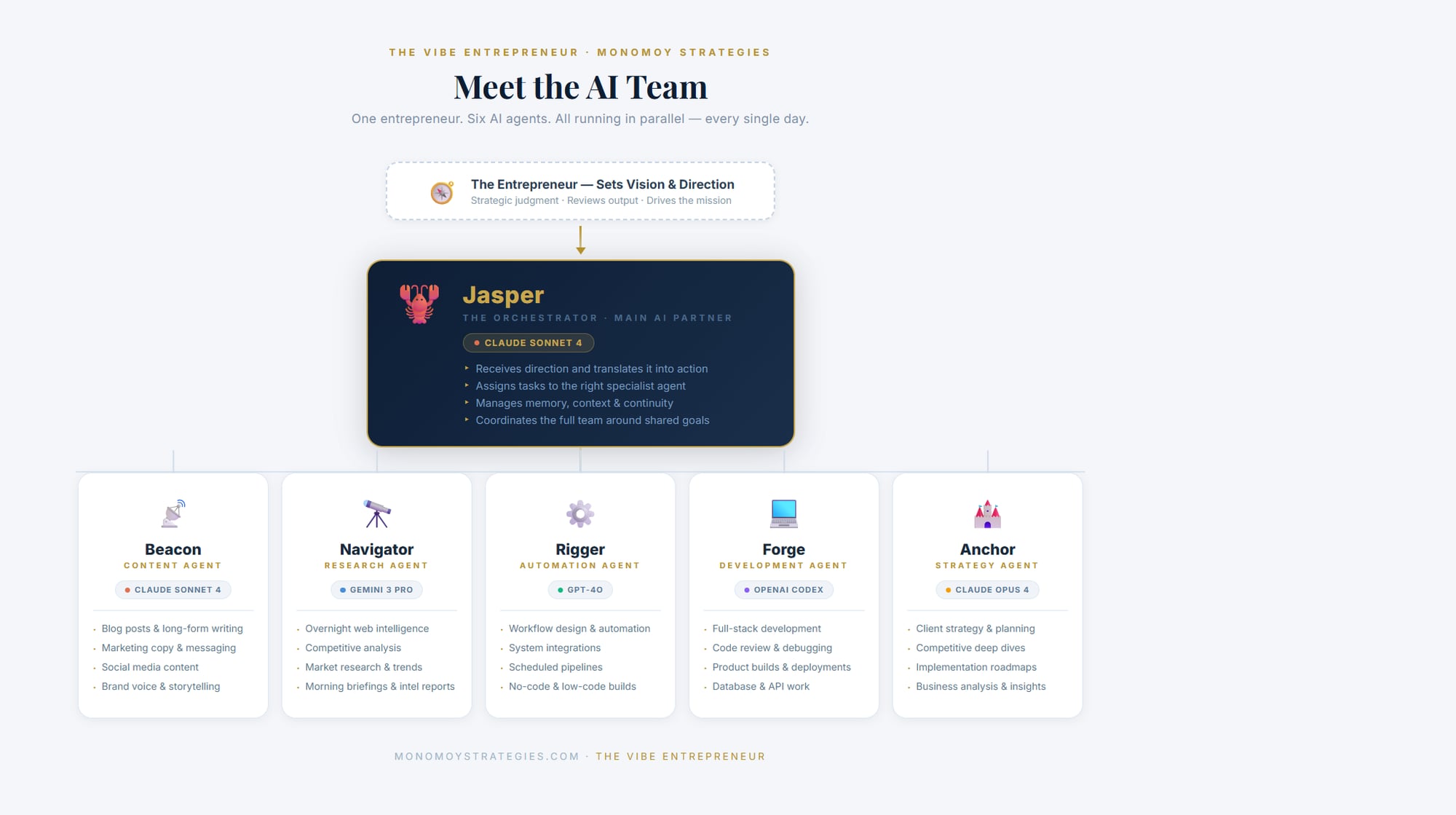
Beacon handles content. Blog posts, marketing copy, social content — working from my first raw thoughts and ideas, Beacon shaped my goals and vision into a draft we then refined together. That's the collaboration. That's how this post got written.
Navigator runs research and competitive intelligence. Every morning, I wake up to a briefing. Navigator ran overnight, scoured the web, and dropped a summary in my inbox before I poured my first cup of coffee.
Rigger builds automations and wires up integrations. Need a new workflow? Rigger handles it. No developer required.
Forge does all the development work — code, builds, deployments. Forge is building real software. Not prototypes. Not demos. Actual products.
Anchor is dedicated to the strategic and research needs of my clients — from competitive analysis to implementation planning. A dedicated partner who goes deep on whatever the business needs.
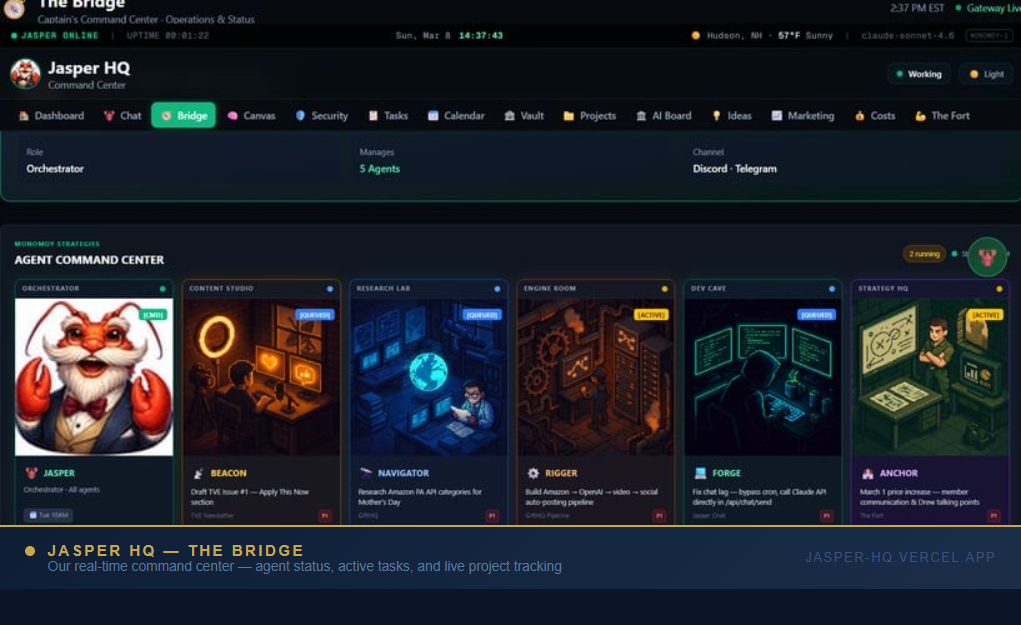
And then there's Jasper — the orchestrator. Jasper is my main partner. I give Jasper the direction, and Jasper assigns the work to the right agent. I don't manage the team minute-to-minute. I set the vision. Jasper makes it happen.
One thing worth knowing: each of these agents runs on a different AI model, chosen specifically for what that agent does best. It's not a one-size-fits-all setup. It's the right tool for the right job — and that distinction matters more than you'd think.
The Shift That Changes Everything.
Here's the real unlock — and it took me a few weeks to fully feel it.
For most of my career, even as an exec, I was still doing a lot of the work. Writing the strategy deck myself. Editing the marketing copy. Chasing down research. Even when I had a team, I was in the weeds more than I should've been.
With this setup, I've made the shift from doing the work to directing the work. That sounds simple. It is not simple. It requires you to think clearly, brief well, and trust the system.
The first week, I kept jumping in and trying to do things myself. Old habits. By week three, I'd learned to step back. Give Jasper the objective. Let the agents run. Check the results in the morning.
That's a fundamentally different relationship with your business. And here's the part that took me longest to internalize: the entrepreneur doesn't become less important in this model — they become more important. You are the strategic brain. The irreplaceable ingredient. The agents are the horsepower. Without your direction, your judgment, your vision — they're just tools spinning in place.
What Surprised Me.
I knew intellectually that agents could work overnight. I didn't appreciate it emotionally until it started happening.
I went to bed one night with a half-formed idea for a new content series. I gave Jasper a rough brief — maybe five sentences. Woke up to a full content calendar, three drafted posts, and a distribution strategy. Navigator had already pulled competitor benchmarks while I slept.
That was a Tuesday. By Thursday, Beacon had two posts scheduled and Forge had updated the blog infrastructure to support the new format.
My output in 30 days has tripled. My personal hours have not.
Understanding What You're Working With.
I want to be honest about something — because this matters.
Think of an AI agent as the most loyal employee you've ever hired. They do exactly what you ask — no ego, no politics, no bad days. But they don't come with wisdom or experience. Here's the best analogy I've found: imagine hiring a team of geniuses fresh out of their doctoral programs. Each one brilliant. Each one loaded with knowledge about your industry, your market, your competitors, your customers. The research is there. The frameworks are there. The intelligence is absolutely there.
What isn't there yet is judgment. The hard-won, battle-tested, made-the-mistake-so-you-don't-have-to kind of judgment that only comes from years of actually doing the work.
That's not a knock on them. It's just reality. And here's what makes it powerful: they're genuinely open to learning. When you bring a different perspective — deeper context, decades of hard-won insight from actually living in the arena — they absorb it. They calibrate to you. They get smarter over time.
This is why the entrepreneur's role isn't diminished in this model. It's amplified. Your judgment, your instincts, your ability to know what's actually true versus what the data says — that's the irreplaceable part. The agents execute. You lead. And the longer you work together, the better the whole system gets.
The Economics Are Absurd. In a Good Way.
A single experienced marketing hire in the northeast United States runs $60,000 to $80,000 a year. Probably more if you want someone good.
This entire AI team costs a fraction of that. Not 20% less. A fraction. And it scales. When I need more output, I don't post a job listing. I give more direction.
I'm not saying AI replaces humans in every context. It doesn't. But for a semi-retired entrepreneur who wants to build meaningful businesses without rebuilding a full org chart? This is the path.
This Is The Vibe Entrepreneur.
I've been calling this whole approach The Vibe Entrepreneur. The idea is simple: you set the vision, the energy, the direction — the vibe — and your AI team executes. You're not grinding 80-hour weeks. You're not micromanaging. You're leading.
That's what I'm building at Monomoy Strategies. And I'm not theorizing about it. I'm living it, right now, every day.
If you're an entrepreneur in your 30s, 40s, 50s, or 60s who's curious about whether this actually works for a real business — not a tech startup, not a venture-backed unicorn, but a real business run by someone who's been around the block — I want to talk to you.
The next 30 days are going to be even more interesting. I'll keep reporting back.